Do you remember your first bike ride — the one without the training wheels? Cycling for adults over 50 offers a chance to rediscover that joy.
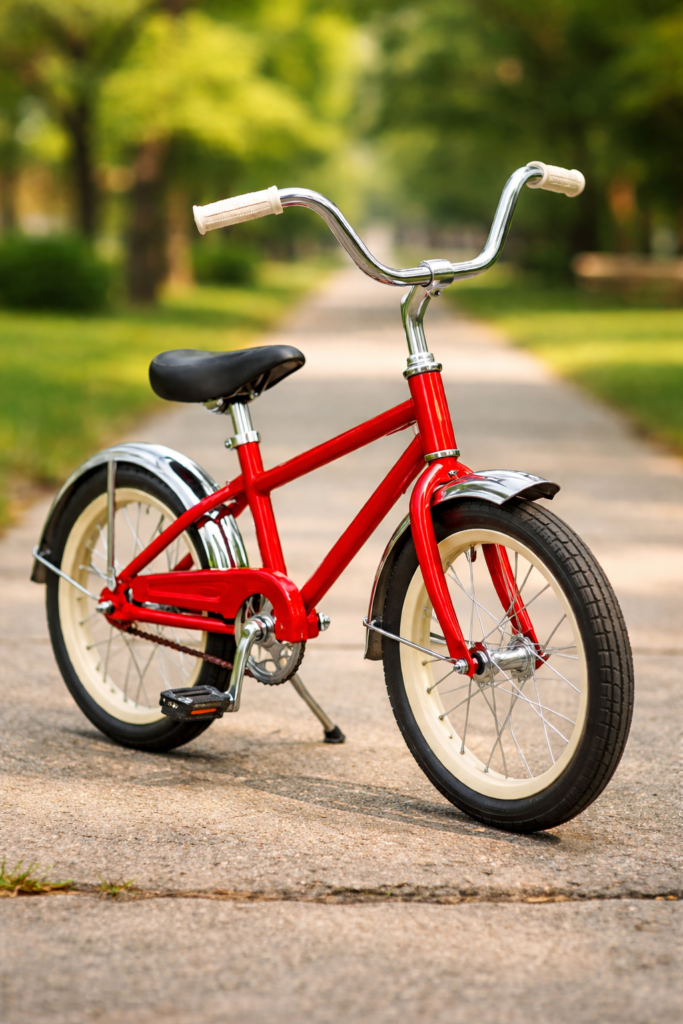
I was five years old when mine came off. The bike was small and red, with shiny chrome fenders and no coaster brakes. If you wanted to coast, you lifted your feet and let the pedals spin wildly beneath you.
It was Columbus, Ohio. Glenn Avenue. A neighborhood of open yards and young families. On a cool Saturday morning in May, beneath a towering sycamore tree dressed in new spring leaves, my father stood behind me.
He didn’t say much at first. He held the seat and steadied the handlebars. His hands were firm — not controlling, just present.
“Pedal, Thomas. Pedal. Go, go!” he called out, his voice equal parts command and encouragement.
The pedals turned. My legs moved faster. I felt his strength behind me; his confidence, really. Then, without warning, his hands left my waist.
He had let go.
For a brief second, there was fear. Then balance.
I rode past the Linkers’ house, then the Paoletti’s. The cool, gentle southern breeze was in my face. Heart pounding. No hands behind me. The sheer joy of it. Then something else seemed to swell in my tiny chest—the sheer freedom.
What I didn’t understand then was this: my father wasn’t just teaching me how to ride, but also how to move forward.
Those first few yards became miles. Then thousands of miles.
And in many ways, I have been riding on that first push ever since May of 1958.
I didn’t know it then, but that first ride planted something deeper than just balance.
My father would often insist to my two older brothers, “Take your little brother along,” when they were going somewhere on their bikes. Their bikes had coaster brakes, and my little red 2-wheeler had none. I had to keep pedaling to keep up! They would get mad at my drag on their plans, having to wait for me. Many times, they just didn’t. I was left to my own devices. This instilled an awareness that “movement changes you.”
The forward motion builds a confidence.
That someone believing in you can carry you farther than you imagine.
Years passed. The red bike gave way to a red Schwinn for longer distances with a rack over the back wheel and saddle bags for a paper route. I bent that frame going down a big hill on dirt, crashing at the bottom of a creek bed.
More freedom slowly matured into discipline.
Taking risks slowly morphed into more curiosity about how things worked. I began asking different questions: What allows the body to adapt? High School biology and chemistry led me to more questions.
That curiosity led me into science.
I pursued a degree in Biological Chemistry, drawn to understanding how the human body works at its most fundamental, molecular level. Not just muscles and motion — but energy systems, recovery, cellular adaptation, physiology. I wanted to understand what makes endurance possible, not just momentarily, but over time, through training.
Cycling never left me.
In Cincinnati, OH, at the university, I had hills to climb, steep ones, to get around the city. Attack the Climb! It evolved with me.
The man who followed was learning why balance in life matters.
As my professional life expanded, the path led me into more than 35 years in the performance supplement industry. I worked in sales, marketing, technical formulation, and CGMP compliance. I saw firsthand how products are created, how claims are tested, and how standards are upheld.
The Curiosity has never left.
I wanted to understand adaptation at its foundation — energy systems, recovery pathways, cellular repair, metabolic resilience. Why do some people grow stronger with age while others decline?
What truly sustains endurance over decades?
What actually works?
What holds up under time and stress?
What helps real folks increase performance?
But there is more to the equation—the psychology of it all. Not all theory for theory’s sake, but answers that could explain what I felt on the road and saw in others.
My journey brought me to earning quality certifications through NASM (National Academy of Sports Medicine)
I stayed in the gym. I’m still there. I teach advanced senior fitness classes. I lead indoor cycling sessions. I work with individuals rebuilding their lives inside recovery environments. I still take courses earning more certifications….
The coursework gave me knowledge.
The gym floor and cycle room provided me with an application.
The road gave me truth.
And slowly, these became a way, a belief, lived every day.
What actually works?
What holds up under time and stress?
What helps real people remain capable?
But science alone isn’t enough.
“And slowly, those three converged into something more than fitness. They became philosophy.”
Then life tested that philosophy. The wheels Fell Off.
In 2008, my spouse suffered multiple cardiac arrests. In an instant, everything that felt structured and forward-moving changed direction. Hospital rooms replaced Boardrooms. Professional momentum slowed. Travel became limited. The future felt less predictable.
I stepped into the role that mattered most — caregiver.
Caregiving is its own endurance sport.
There are no medals, no finish lines, no applause. There is only presence. Trying patience you didn’t know you had. Almost constant underlying stress. Hidden strength that others see, but you don’t, because you are in the thick of it. Others are looking outside – in.
During that passage , movement took on a new meaning.
Early morning rides were no longer about increasing performance. They became a conduit for mental stability, anchoring me for the trying day ahead. They provided the notion that onward motion is still possible, even when circumstances feel uncertain. The rhythm of pedaling and the sounds of nature outside improved my creative thinking. This quiet effort centered my mind.
I wasn’t chasing a fitness goal per se.
I was preserving three capacities; physical, mental, and emotional.
Then came the severe financial difficulties.
Career plans pivoted. But one truth became unmistakable: strength after 50 isn’t accidental. It is cultivated. And oftentimes, it is grown precisely because life demands more of you.
“The bike was no longer just freedom.
It was stability.”
That passage clarified something I had sensed for years but never fully articulated:
Aging is not the total enemy. Neglect is the major nemesis.
After 50, the rules change , but the opportunity still exists. The body may not recover as quickly, but it still adapts with the proper direction and protocol. The muscles yet respond. The heart still strengthens. The mind is still sharp. What changes is not potential. What changes is intention.
Youth relies on momentum. Maturity relies on discipline.
The difference between decline and durability often comes down to one simple decision repeated daily: Show Up.
Not recklessly. Not ego-driven. Intelligently. Consistently.
Strength after 50 is not about chasing who you once were. It is about protecting who you are becoming. It is about maintaining independence and preserving mobility, sustaining clarity, and remaining capable in a world that quietly expects you to slow down.
Experience, when paired with effort, becomes an advantage.
You understand your limits better. You understand your motivations more clearly. You no longer move to impress. You move to endure.
That is when training becomes practice.
Practice becomes resilience.
Resilience becomes freeing.
And freedom, I’ve learned, is not the absence of challenge.
It is the ability to move forward despite it.
Who Is This For?
Bicycle High isn’t for everyone.
It’s for those who feel that something inside them still wants to move forward.
It’s for adults over 50 who understand that strength is no longer about proving — it’s about preserving. For men and women who want to remain capable, independent, and engaged in their own lives.
Many find that Cycling for adults over 50 not only keeps them fit but also reconnects them with their youth.
It’s for those returning to movement after setbacks. For caregivers carrying quiet loads. For riders who may not be the fastest anymore, but who refuse to be finished.
It’s for people who value experience. Who understands that wisdom and discipline can outperform youth and intensity. Those who are willing to train intelligently, recover intentionally, and approach aging with responsibility rather than resignation.
You don’t have to be elite.
You don’t have to be fearless.
You have to be willing to show up.
If you believe that strength after 50 is something you build…. not something you lose…then you are exactly who this is for.
The Invitation
Looking back, I realize something about that morning on Glenn Avenue.
My father didn’t ride the bike for me.
He steadied it.
Then he let go.
That’s what Bicycle High is meant to be.
Not a program built on hype. Not a shortcut. Not a promise of youth regained. It is steady guidance. Intelligent training. A reminder that you are still capable……and still moving forward.
You already have the legs.
You already have the miles.
You already have the experience.
What you may need is Rhythm. Direction. Community.
If something in this story feels familiar — if you recognize that quiet desire to remain strong, independent, and purposeful — then you are in the right place.
We ride forward here.
Not to relive who we were.
But to protect who we are becoming.
Stay moving.
Stay capable.
B Positive.