
I’ve been a caregiver for over 17 years, and at times, my bicycle has been my best friend.
It was September of 2008, and a beautiful day. I’ll always remember exactly where I was and what time of day it was when I got that dreaded call. “ It was Deborah’s superior at work. “ Tom, Deb collapsed at work and is in an ambulance on our way to Mid-Island Hospital.
She suffered 4 cardiac arrests in less than an hour that day in September. To shorten this part of the story, the result was that Deb had suffered from anoxic encephalopathy. Her short-term memory was severely impaired, and so was her cognitive function9⁸
My life changed in an instant. Everything upside down… my whole world was tilted. I’ll continue to share the story from that fateful day to the present, but that’s not the topic that I wish to share with you in this post.
Yes, I took on the additional role of wife, but not mother. It wasn’t just me whose world was shaken to the foundation, but my children’s as well.
The underlying stress is always there.
The pressures of making sure she is healthy, well-fed, and, most importantly, happy and loved are tensions that only other caregivers could know and understand.
I don’t think I could perform this role without the help of my bicycle. The bicycle brings me joy, yes, but that joy comes from the different uses I have created for it.
Early morning Joy ride
Indoor Group Cycling Instruction at the YMCA
Club Rides
I am glad that there are not that many people who have spent over 15 years in a full-time caregiving role.
It gets brutally lonely sometimes.
My world is very small sometimes.
So you see, it’s about maintaining my mental health.
Staying Positive like my blood type….a 2 word imperative sentence
B Positive….
They extend beyond physical fitness; they also encompass mental clarity and emotional resilience.
I know and understand the science, psychology, and the benefits of cycling, not only for my situation, but for all of us who love to ride.
Many studies highlight the advantages in enhancing cognitive function and promoting neurogenesis.
This is where cycling becomes genuinely remarkable for the over-50 rider — and where it separates itself from many other fitness modalities.
Exploring the Benefits of Over50 Cycling
I am just going to highlight one of the most important benefits for me in my role. I know it’s also great for all of us.
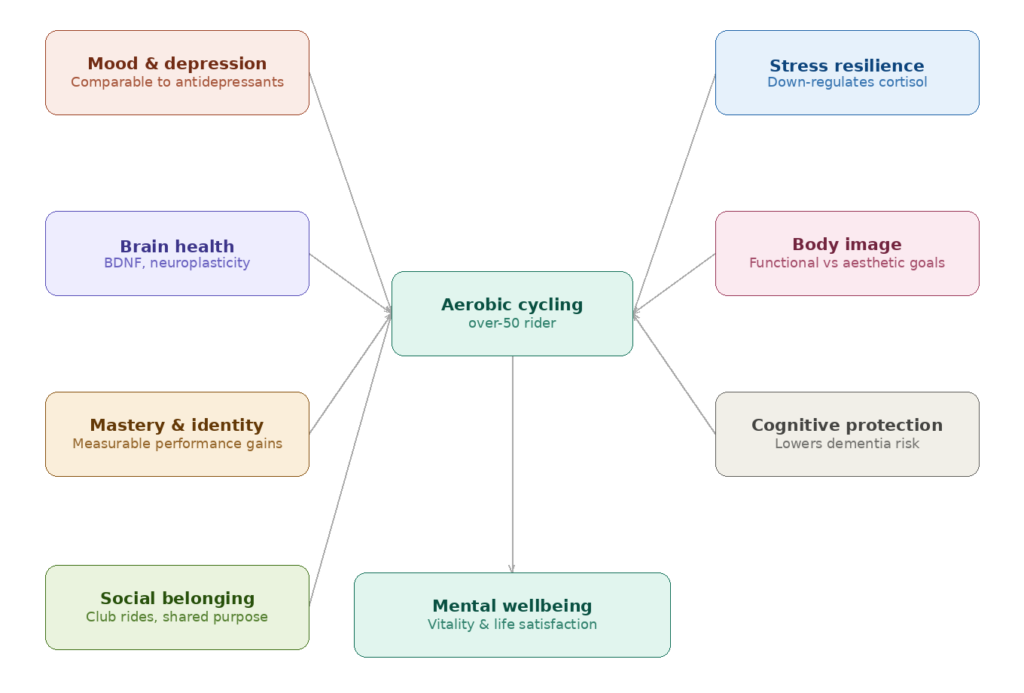
Depression and anxiety reduction. This is huge for me. Read On…
Aerobic exercise is clinically comparable to antidepressant medication in treating mild-to-moderate depression. For people over 50 facing retirement transitions, empty nest, loss of identity, or grief, this is profound. Cycling triggers sustained release of endorphins, serotonin, dopamine, and BDNF (brain-derived neurotrophic factor).
Why BDNF declines after 50
Several converging factors suppress BDNF as we age. Chronic stress elevates cortisol, which directly suppresses BDNF gene expression. Sedentary behavior removes one of the most powerful stimulants of BDNF production.
Poor sleep — increasingly common after 50 — disrupts the overnight consolidation processes that BDNF supports. Diet also matters: ultra-processed foods and excess sugar are associated with lower BDNF, while omega-3s and polyphenols support it. (More on this in a subsequent post.
The result is a gradual erosion of the brain’s capacity to rewire, repair, and remember — which is why cognitive decline feels like it accelerates in the 50s and 60s for many people.
How cycling specifically elevates BDNF
Aerobic exercise is the single most reliable non-pharmacological way to raise BDNF, and the mechanism is well understood. During sustained aerobic effort, the kind I maintain on a 60–90 minute ride — several things happen in sequence:
Muscle contractions release a molecule called irisin, which crosses the blood-brain barrier and stimulates BDNF production in the hippocampus. Simultaneously, increased blood flow delivers more oxygen and glucose to the brain, and the resulting metabolic activity amplifies BDNF gene expression.
What is Gene Expression you ask?
Simply, Gene expression is the process by which the information encoded in a gene is used to produce a functional product; nearly always a protein.
The elevation isn’t trivial — studies have shown acute BDNF spikes of 200–300% above baseline immediately after moderate aerobic exercise. BDNF (Brain-Derived Neurotrophic Factor) is itself the protein that gene expression produces.
Cognitive protection. BDNF is sometimes called “Miracle-Gro for the brain.”
Aerobic exercise is the most reliable non-pharmacological way to elevate it. BDNF promotes neuroplasticity, protects against age-related memory decline, and appears to reduce the risk of Alzheimer’s and dementia.
The over-50 cyclist is literally preserving their brain on every 60- to 90-minute ride!
There is so much more to tell. And I will.
I so much appreciate you visiting me here at Bicyclehigh.com.
Keep Riding……Together.
Cotman, C. W., & Berchtold, N. C. (2002). Exercise: A behavioral intervention to enhance brain health and plasticity. Trends in Neurosciences, 25(6), 295–301. https://d
oi.org/10.1016/S0166-2236(02)02143-4
Erickson, K. I., Voss, M. W., Prakash, R. S., Basak, C., Szabo, A., Chaddock, L., … Kramer, A. F. (2011). Exercise training increases size of hippocampus and improves memory. Proceedings of the National Academy of Sciences, 108(7), 3017–3022. https://doi.org/10.1073/pnas.1015950108
Sleiman, S. F., Henry, J., Al-Haddad, R., El Hayek, L., Abou Haidar, E., Stringer, T., … Chao, M. V. (2016). Exercise promotes the expression of brain derived neurotrophic factor (BDNF) through the action of the ketone body β-hydroxybutyrate. eLife, 5, e15092. https://doi.org/10.7554/eLife.15092
Liu, P. Z., & Nusslock, R. (2018). Exercise-mediated neurogenesis in the hippocampus via BDNF. Frontiers in Neuroscience, 12, 52. https://doi.org/10.3389/fnins.2018.00052
Marais, L., Stein, D. J., & Daniels, W. M. U. (2009). Exercise increases BDNF levels in the striatum and decreases depressive-like behavior in chronically stressed rats. Metabolic Brain Disease, 24(4), 587–597. https://doi.org/10.1007/s11011-009-9157-2