
I lead cycling for older adults indoor classes at the YMCA of St. Petersburg, Florida, and I do this for several reasons.
First, I believe it is important to lend your strength to others. I am happiest when I am in service to other people. Second, as a long-term full-time caregiver, it is important for me to be with others in a positive setting. That human interaction supports my mental health, steadies my outlook, and helps me stay on course. Third, I benefit from the 50-minute workout too.
That is why I want to share my thoughts on cycling for older adults and why I believe it is one of the best longevity routines available.
Why I Lead Indoor Cycling Classes
There is something powerful about a room full of people working together toward better health. Group exercise creates accountability, social connection, and positive energy. For me, that matters on a personal level.
As a caregiver, I know how important it is to protect mental outlook and maintain meaningful human interaction. Teaching cycling gives me that. It also allows me to encourage others to keep moving, keep showing up, and keep investing in their health. I believe that matters more with age, not less.
Cycling and Longevity in Older Adults
Group cycling may be one of the best longevity routines for older adults because it supports the entire body while remaining relatively easy to perform, enjoyable in a group of like-minded people, and sustainable over time.
Unlike high-impact activities that can be hard on aging joints, such as running, cycling provides an effective cardiovascular workout with relatively low orthopedic stress. That means more people can do it regularly without excessive wear and tear.
To me, consistency is a key performance indicator in almost every meaningful part of life. Exercise is no exception. You do not need a heroic workout plan. You need a routine that you can repeat week after week. Cycling fits that requirement very well.
How Cycling Supports Cardiovascular Health
Regular cycling helps strengthen the heart, improve circulation, and support healthy blood pressure. It also contributes to better blood sugar control, weight management, and metabolic health, all of which are closely tied to healthy aging.
These are foundational benefits. If we want to live longer and better, we have to support the systems that keep us active and functional. Cardiovascular health is central to that equation.
Beyond heart health, cycling also helps preserve muscular endurance and physical work capacity. It trains the body to produce and sustain effort in a controlled, low-impact way.
Cycling, Leg Strength, and Sarcopenia Risk
Cycling also helps improve and preserve leg strength, and that has major implications for healthy aging.
This is especially important in reducing the risk of sarcopenia, the age-related loss of muscle mass and strength. Sarcopenia can lead to weakness, reduced mobility, poorer balance, and loss of independence. That is one of the major reasons older adults need regular physical activity.
Cycling is not a substitute for resistance training, but it absolutely increases leg strength in a meaningful way. It keeps the quadriceps, hamstrings, glutes, and calves working on a regular basis. That kind of muscular activity matters in real life. It matters when you stand up from a chair, climb stairs, walk with confidence, or carry groceries.
I will address prevention strategies for sarcopenia in more detail in a future post, because that topic deserves its own discussion.
The Mental Health Benefits of Cycling
Cycling also supports mental well-being. Aerobic exercise is associated with reduced stress, improved mood, and better cognitive health. In my experience, these mental health benefits are influenced by exertion level.
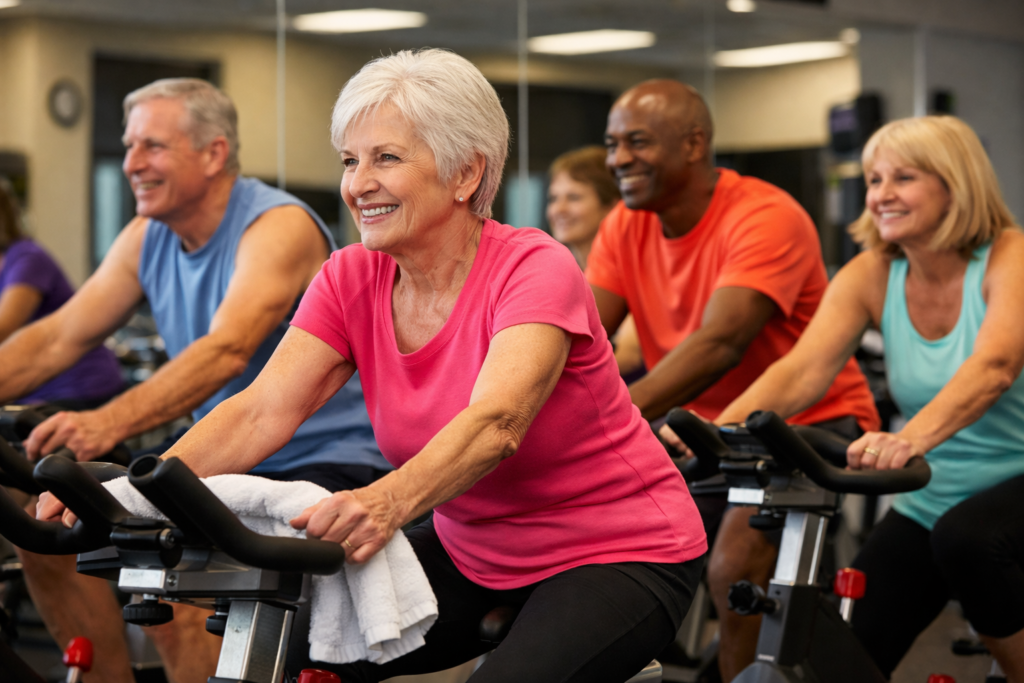
An elevated heart rate, approximately 75 percent of maximum heart rate, in an interval training format, seems to produce some of the best results. That combination of effort, rhythm, and recovery can leave people feeling clearer, lighter, and more positive.
For many older adults, cycling offers more than exercise. It provides routine, structure, community, and a sense of forward motion. Those are valuable benefits at any age, but especially as we get older.
Why Consistency Matters More Than Intensity
One of the biggest reasons cycling works so well is that it is sustainable. Regular cycling, at a minimum of two times per week, can support both lifespan and health span. You do not have to be an athlete to benefit. You simply need to begin and keep going.
Longevity is not only about living longer. It is about living better. It is about preserving strength, mobility, endurance, and mental resilience for as long as possible.
For that reason, I believe cycling is one of the smartest routines older adults can adopt.
Join Our Community
I do not know much about you yet, but I would like to. Join the BicycleHigh Community. Click Here
If this message speaks to you, sign up for our bulletin and join our community. We are building something positive, practical, and encouraging for older adults who want to stay strong, active, and engaged.