
This is a repost from my solidtothecore.com site. I thought it would be great to share with you, my bicyclehigh community.
It’s not your imagination. Here’s what’s actually happening inside your cells.
What metabolism actually is
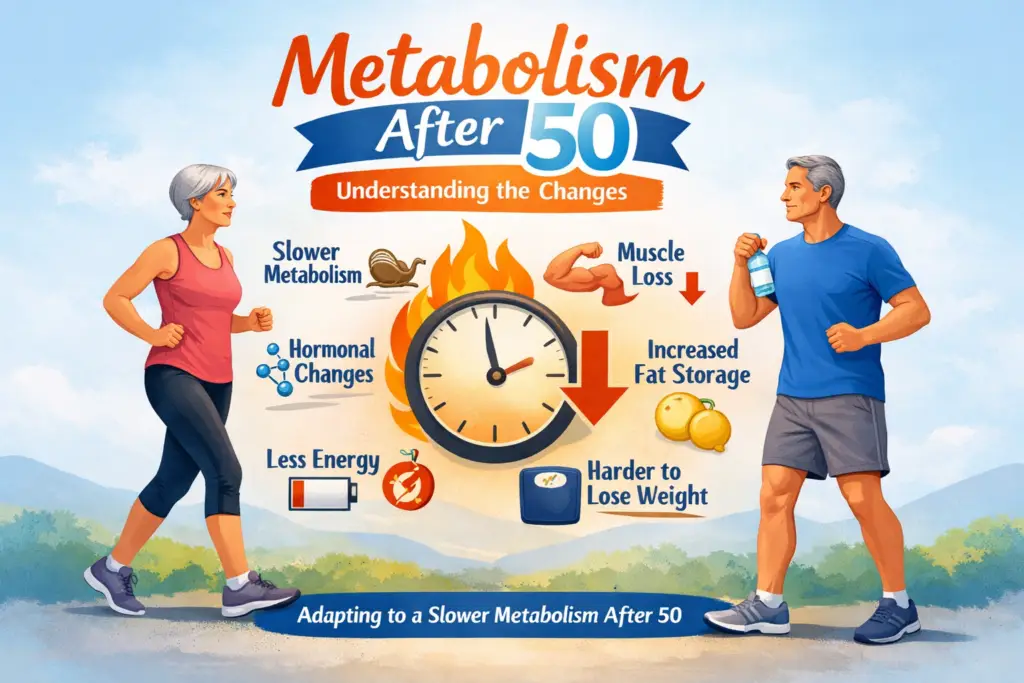
Understanding your metabolism after 50 can help you adapt to these changes.
Metabolism after 50 is the sum of every chemical reaction your body uses to sustain life — converting food into energy, building and repairing tissue, regulating hormones, and clearing waste. Think of it less like a dial and more like an orchestra: dozens of systems playing in concert, 24 hours a day.
At its core, metabolism has two directions:
Catabolism — breaking down
Carbohydrates, fats, and proteins are dismantled to release ATP (adenosine triphosphate) — the body’s actual fuel currency.
Anabolism — building up ATP is used to synthesise new molecules — muscle fibres, enzymes, hormones, collagen. This is where recovery and growth happen.
Where your calories actually go
| RESTING (BMR) ~70% |
| DIGESTION (TEF) ~10% |
| MOVEMENT (NEAT) ~20% |
Total daily energy expenditure (TDEE) is made up of three components. The breakdown surprises most people:
BMR = basal metabolic rate NEAT = non-exercise activity thermogenesis TEF = thermic effect of food
Your resting rate — what your body burns just to keep the lights on — accounts for roughly 70% of all calories used. This is why muscle mass matters so much: muscle tissue is metabolically expensive, consuming energy even at rest.
Fast vs. slow metabolizers — what this actually means
“Fast” and “slow” metabolism refers primarily to the rate at which your basal metabolic rate operates, influenced by several interacting factors:
| Fast metabolizer Higher lean muscle mass, elevated thyroid output, denser mitochondria per cell, and efficient enzyme activity. Burns more calories at rest and recovers substrate faster during exercise. |
| Slow metabolizer Lower muscle-to-fat ratio, reduced thyroid hormone sensitivity, fewer active mitochondria. Substrate (glucose, fatty acids) clears more slowly — not broken, just different. |
| The mitochondria in your muscle cells are the engines of metabolism. Each cell can contain hundreds to thousands of them. Exercise — particularly resistance and interval training — stimulates mitochondrial biogenesis: your body literally builds more of them at any age. |
KEY CONCEPT
What “metabolically expensive” actually means
“Metabolically expensive” means a tissue or process requires a significant, ongoing calorie cost just to exist or operate — even when you’re doing nothing.
Think of it like a building’s utility bill. Some rooms (muscle) run the heat, lights, and equipment around the clock. Others (fat storage) just sit there with the lights off.
Why muscle is expensive
Each pound of skeletal muscle burns roughly 6–10 calories per day at rest — just maintaining its protein structures, ion gradients across cell membranes, and mitochondrial activity. A person with 10 more pounds of lean muscle than average burns an extra 60–100 calories daily doing absolutely nothing.
The “expense” comes from several simultaneous demands:
- Protein turnover — muscle fibres are constantly broken down and rebuilt, consuming ATP at a significant rate
- Ion pump maintenance — keeping electrochemical gradients across cell membranes ready to fire requires continuous energy
- Mitochondrial upkeep — muscle cells house large numbers of mitochondria, which themselves have metabolic overhead
- Calcium cycling — even at rest, low-level calcium signalling in muscle cells consumes energy
By contrast, fat tissue burns roughly 2 calories per pound per day at rest — about one-quarter the rate of muscle. It’s metabolically cheap to carry.
| When sarcopenia quietly removes muscle mass over the years, the body is downsizing its most expensive tenants. The result is a lower BMR — not because metabolism “broke,” but because there’s simply less high-demand tissue to feed. |
INSIDE THE CELL
Mitochondria: the fuel-burning organelle
Every cell in your body that burns energy does so through a remarkable structure called the mitochondrion. A single muscle cell can contain hundreds to thousands of them, clustered around the fibres that need power most.
How the fuel cycle works
Step 1 — Glycolysis (outside the mitochondria): Glucose from food is broken down in the cell’s cytoplasm into pyruvate, producing a small amount of ATP — 2 molecules per glucose.
Step 2 — Entry: Pyruvate crosses the outer membrane and converts to acetyl-CoA. Fatty acids from stored body fat enter the same pathway here. This is where carbohydrate and fat fuel sources converge.
Step 3 — The Krebs cycle (matrix): Acetyl-CoA enters a loop of 8 chemical reactions that strips electrons from the fuel and captures them in carrier molecules. The carbon backbone is released as CO₂ — literally the breath you exhale.
Step 4 — Electron transport chain (cristae): The folded inner membrane is packed with protein complexes that pass electrons down an energy gradient, driving a molecular turbine called ATP synthase. This single stage produces ~32–34 ATP per glucose molecule.
Step 5 — ATP exits: Adenosine triphosphate powers every energy-demanding process in the cell — muscle contraction, protein synthesis, nerve signals. When a cell is working hard, mitochondria spin up production. When idle, they throttle back.
| Exercise literally trains mitochondria to become more numerous and more efficient. More mitochondria = higher metabolic rate, better endurance, faster recovery. This is called mitochondrial biogenesis — and it happens at any age. |
THE 50+ REALITY
Sarcopenia: the silent driver behind almost everything
You didn’t gain weight. You lost muscle.
That sentence lands differently at 52 than it does at 32. You may be eating roughly the same. Moving roughly the same. But something has quietly shifted — clothes fit differently, stairs feel heavier, and recovery from a hard weekend takes a day longer than it used to. Most people assume they’ve “slowed down.” The more precise explanation is that they’ve lost engine.
The clinical name is sarcopenia — from the Greek for “poverty of flesh.” It isn’t a disease. It’s a biological process, as natural as grey hair, and just as open to being slowed down.
What happens to your muscle fibres
Skeletal muscle is made of individual fibres bundled together like cables in a rope. You have two main types: slow-twitch fibres (Type I) that power sustained, steady activity — walking, cycling, standing — and fast-twitch fibres (Type II) that fire for explosive effort — a quick sprint, catching yourself from a stumble, lifting something heavy off the ground.
After 50, your body preferentially loses the fast-twitch fibres first. This is partly why the things that feel harder with age aren’t the slow, steady ones — it’s the quick, reactive ones. Jumping up from a chair. Reacting to a curb. Catching a bag that slips. That’s Type II fibre loss making itself known in daily life.
| LOSS RATE BEFORE 50 ~0.5–1% per year |
| LOSS RATE AFTER 60 up to 3% if sedentary |
| FIBERS LOST BY 80 30–40% of peak count |
The four biological drivers
Hormonal decline. Testosterone, estrogen, and growth hormone — all key signals for muscle protein synthesis — decline measurably through your 50s and 60s. With lower signal strength, the repair cycle tips toward net loss.
Motor neuron loss. Each muscle fibre is controlled by a motor neuron. When a neuron dies, the fibres it controlled are either adopted by a neighbouring neuron (if you’re active enough to maintain neural demand) or they atrophy and disappear. This is one reason strength training is so powerful at this stage: it keeps those neural connections firing and maintained.
Protein turnover inefficiency. Your body constantly breaks down and rebuilds muscle protein. But after 50, the rebuild side becomes less efficient. Research consistently points to 1.2–1.6 grams of protein per kilogram of bodyweight per day as the target for active adults over 50 — roughly double the minimum for sedentary adults.
Anabolic resistance compounding everything. A week of bed rest in a 70-year-old can cause more muscle loss than the same week in a 25-year-old. The muscle simply doesn’t respond to the same stimuli as strongly. Which means the window for maintaining muscle is open, but it’s narrower, and it rewards consistency over bursts.
| None of this is a sentence. It’s a set of levers. Muscle at 60, 65, even 70 responds to resistance training stimulus in ways that are physiologically meaningful. The research on this is not ambiguous. |
COMING IN PART TWO
What you can actually do about it
Part Two covers the practical side: how to read your own metabolic signals, what resistance training actually does at the cellular level after 50, protein timing, sleep and cortisol, and the hormonal levers you can meaningfully influence.
Part One of a two-part series on metabolism and active aging.
References
1. Sarcopenia — molecular mechanisms and the four biological drivers Nguyen TT et al. Sarcopenia and muscle aging: updated insights into molecular mechanisms and translational therapeutics. Endocrinology & Metabolism (Seoul). 2025.https://www.e-enm.org/journal/view.php?doi=10.3803/EnM.2025.2656
2. Muscle loss rate — ~1% per year after 50, accelerating post-60 Dao T, Green AE, Kim YA et al. Sarcopenia and muscle aging: a brief overview. Endocrinology & Metabolism (Seoul). 2020.https://pubmed.ncbi.nlm.nih.gov/33261326/
3. Mitochondrial dysfunction as a key driver of sarcopenia and metabolic decline Frontiers in Cell and Developmental Biology Mitochondrial dysfunction in age-related sarcopenia: mechanistic insights, diagnostic advances, and therapeutic prospects. Frontiers in Cell and Developmental Biology. 2025.https://www.frontiersin.org/journals/cell-and-developmental-biology/articles/10.3389/fcell.2025.1590524/full
4. Exercise stimulates mitochondrial biogenesis at any age — the PGC-1α pathway Drake JC, Wilson RJ, Yan Z. Molecular mechanisms for mitochondrial adaptation to exercise training in skeletal muscle. FASEB Journal. 2016. https://pmc.ncbi.nlm.nih.gov/articles/PMC6137621/
5. Protein intake of 1.2–1.6 g/kg/day for muscle maintenance in adults over 50 Baum JI, Kim I-Y, Wolfe RR. Protein consumption and the elderly: what is the optimal level of intake? Nutrients. 2016 (ESPEN Expert Group, PMC4208946). https://pmc.ncbi.nlm.nih.gov/articles/PMC4208946/
6. Fast-twitch (Type II) fibre preferential loss and motor neuron dropout in aging muscle Various authors. Molecular constraints of sarcopenia in the ageing muscle. Frontiers in Aging. 2025.https://www.frontiersin.org/journals/aging/articles/10.3389/fragi.2025.1588014/full
This bibliography is intended for editorial reference and fact-checking. It does not constitute medical advice. Readers with health concerns should consult a qualified healthcare professional.