
When Caregiving Pulls the Wheels Out From Under You
Recovery isn’t weakness. Sometimes it’s the hardest ride of all.
It’s Saturday morning. I haven’t been on my bike; on the road for two weeks.
I knew last night I wasn’t going to ride this morning. I didn’t fight it. I just knew.
“It was another tough week on the caregiving front. And cycling recovery, I’ve learned, isn’t just physical; it’s also everything the body carries.”
The Flat That Started It
It started the Saturday before. I was barely a mile into the ride when I got the flat. I dismounted, looked at the tire, looked at the road, and made a decision: I’m walking back to the parking lot. I wasn’t going to change a flat on the road that day.
I told myself several weeks ago: Next time I flat, I’m replacing the tires and truing the wheels. I have the equipment. I’ll do it right.
And I did — Sunday. New tires. New drivetrain. Everything dialed in.
The Morning I Knew Something Was Off
Monday, I sat up on the edge of the bed and fell back into a half-dream. Sitting up. That has never happened to me.
Getting to the kitchen to start coffee felt like climbing a hill in the wrong gear. I just wanted to go back to bed. But I had to teach the 8:00 Fit for Life class at the Y across the street. You show up. That’s the deal.
On the scale: 180 lbs. I knew what that meant. I hadn’t been cooking. I’d been going out, spending money on the wrong food, eating my way through the stress. Bad for me. Bad for Deb.
And then a question hit me as I sat there; the kind that stops you cold.
Is this what Deb feels like every single day? Not wanting to move at all?
I sat with that for a moment. Then I made my music set for class, showed up, led the workout, and came home. She was still in bed. I got her up, same as every day. Same resistance. Same refrain.
“What for?”
“Because it’s 11:30, Deb. Because it’s time.”
The Week That Followed
We had appointments stacked — X-ray, bloodwork, a surgery this last Thursday. We came through it. But stress doesn’t end when the appointment is over. It steps down a level or two and keeps moving. Mine had been creeping up every day for weeks.
I held it at bay with yoga, meditation, and cognitive breathing — tools I’ve built into my routine over time. Blood pressure was peaking at 145 in the afternoons, coming back down to 128–132 in the evenings. Stage one. Sometimes edging toward stage two. Not a crisis. But a signal.
The body was talking. After 18 years, you learn to listen.
What Cycling Recovery Actually Looks Like
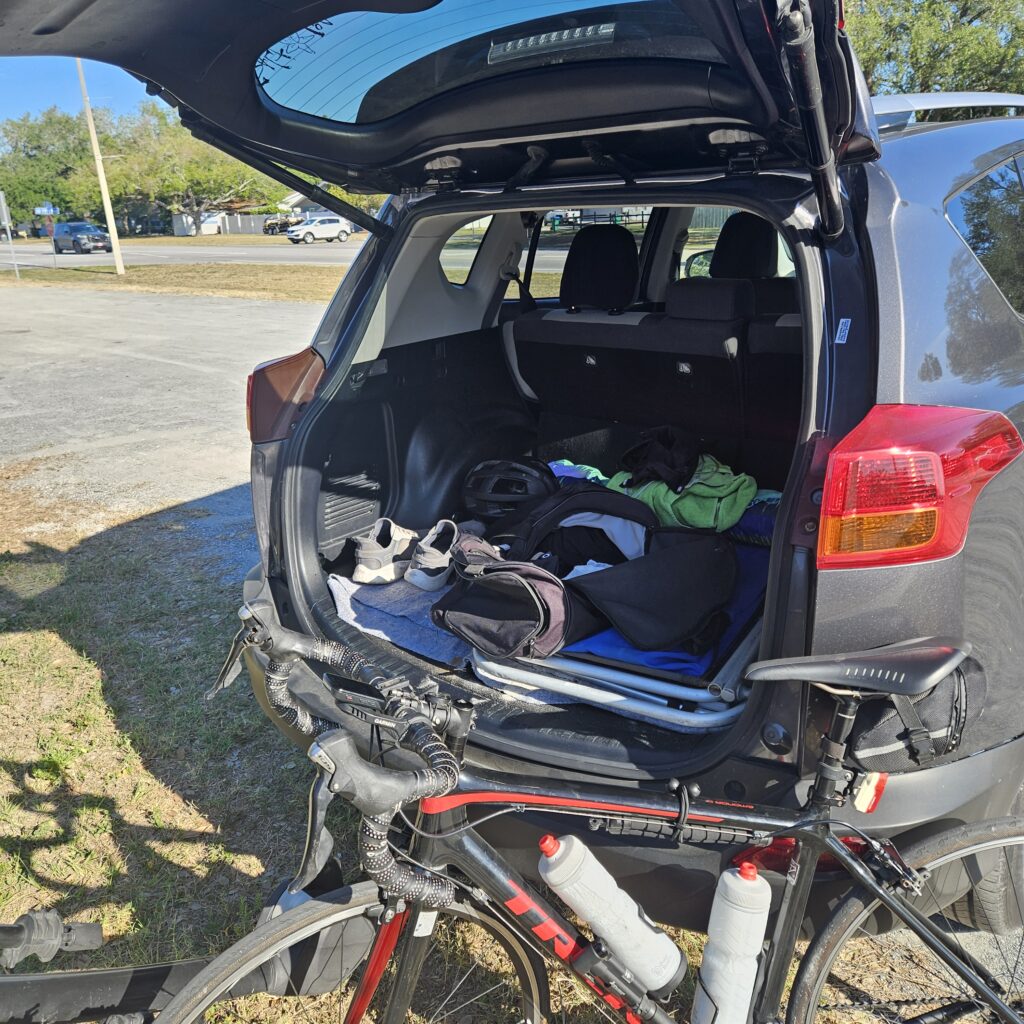
Here’s what I told myself Saturday morning, sitting with my coffee instead of clipping into my pedals:
Be patient. You led back-to-back classes yesterday. You’ll get in an indoor ride with your group tomorrow. Today you need to catch up on consulting work and write. That’s the ride for today.
That was the self-talk. The emotional intelligence.
Because here’s the thing about recovery that cyclists; especially amateur commited ones tend to get backwards: rest is not the absence of training. It is training. Your muscles don’t get stronger on the bike. They get stronger in the hours after, when you let them.
The same is true for your nervous system. For your blood pressure. For your mind.
When life adds the weight of caregiving on top of training load, the math changes. You don’t subtract the caregiving. You account for it. You adjust. And we are older.
Five Things I’m Doing Right Now Instead of Riding
If you’re in a stretch like mine — fatigue, stress, life crowding the calendar; here’s what I’m leaning on:
1. Sleep first, everything else second. Not negotiable this week. If the choice is an early ride or another hour of sleep, sleep wins. Hormonal recovery, blood pressure regulation, immune function — it all happens while you’re horizontal.
2. Nutrition re-set, no drama. I was eating out of exhaustion and emotion. That stops. Simple, anti-inflammatory food — not a diet, not a program, just cooking again. Eggs, fish, greens, olive oil. Food that works for me.
3. Blood pressure monitoring — twice daily. Morning and late afternoon. I’m tracking the trend, not panicking over individual readings. Context matters. Stress matters. Hydration matters. If it stays elevated for more than two more weeks, I make the call.
4. Short, intentional movement instead of big efforts. Yoga. Walking. The Fit for Life class I’m teaching. This isn’t nothing — it’s active recovery. It keeps the body moving without adding to the load.
5. The self-talk audit. What am I saying to myself when I’m tired? When I’m scared? When I can’t get her out of bed and I’m running on empty? I’m paying attention to that now. The inner voice during a hard stretch matters as much as the voice that pushes you through the last bridge to climb.
Cycling Recovery The Road Will Still Be There
I miss the road. The lakes. The trees. The birds. The Gulf. The salt air moving through you when you’re finally in a rhythm and the miles start coming easy.
I will be back on it. Soon. Stronger for having stopped.
But right now, recovery is the work. Not glamorous. Not Strava-worthy. But real, and necessary, and harder than most rides I’ve done.
If you’re in a stretch like this — whatever the cause — know that stepping back is not falling behind. It’s the most disciplined thing a serious cyclist can do.
Are you managing training around caregiving, illness, or high stress? I’d like to hear what’s working for you. Leave a comment below or reach out directly.